
Big trees, old neighborhoods, wet springs and icy winters
Tree Service in Shreveport, LA
Pruning and removal planned around Red River weather, older lots and overhead lines.
- Every estimate done in person around Shreveport and nearby towns
- The written quote lists what is and is not included
- Debris and stump handling decided in advance
Tree Work in a City Built Among the Pines
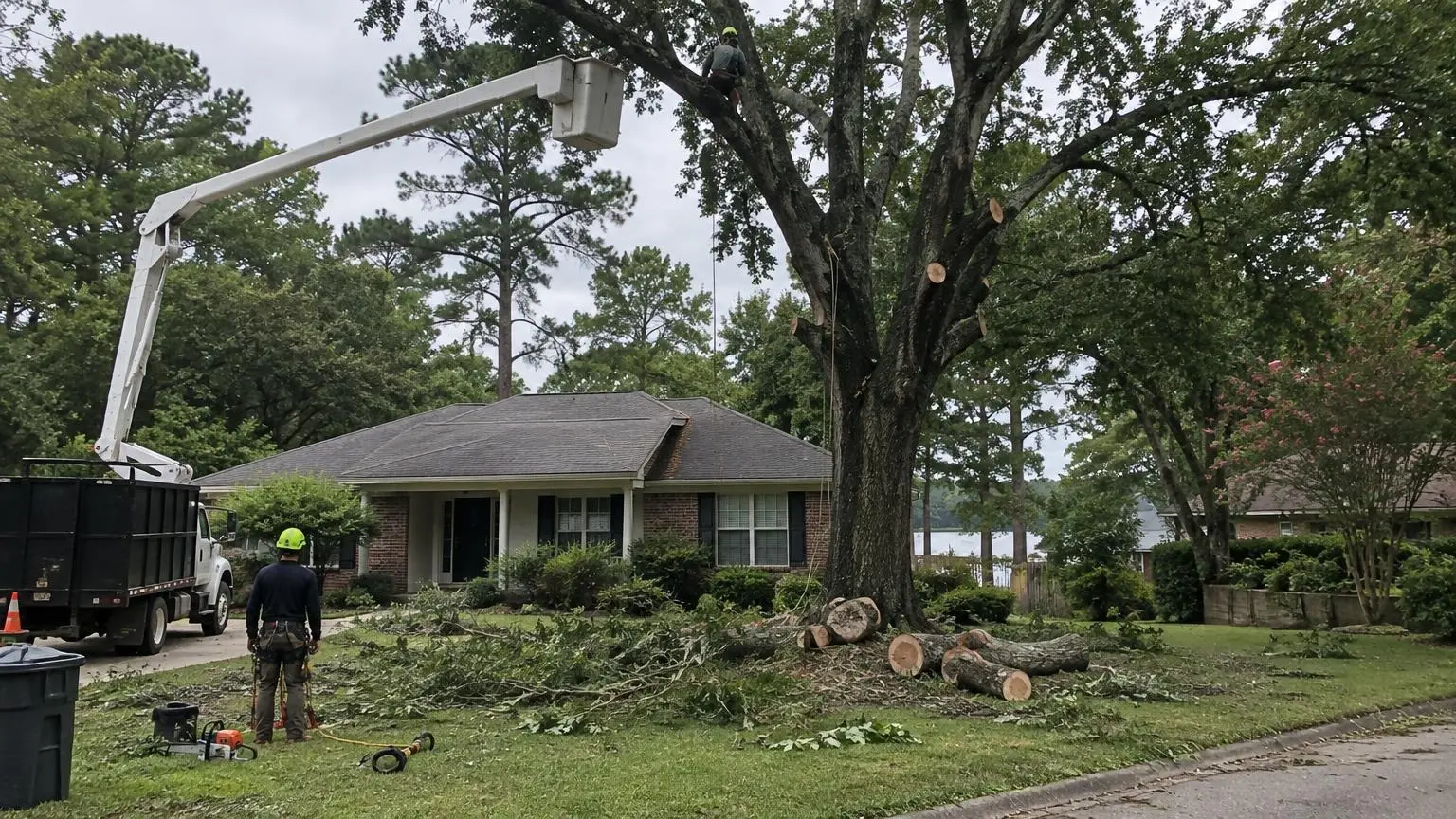
Tree Service in Shreveport means working in a city that grew out of a forest. Shreveport was founded in 1836 where the Red River met the Texas Trail, after Captain Henry Miller Shreve's crews cleared the Great Raft, a log jam roughly 180 miles long that had choked the river. The pine forests, bottomland and bayous that surrounded the early town still ring the city today, and many of the trees standing over Shreveport roofs are older than the houses beneath them.
Two seasons that test trees
Shreveport averages a little over 51 inches of rain a year, with April the wettest month, and it logs around 91 days above 90 degrees. Spring and summer bring the severe thunderstorms, hail, straight-line winds and tornadoes that this part of the country knows well. Winter is shorter, but it is not harmless: the city averages about 35 days at or below freezing, and ice and sleet storms come through often enough that most homeowners have seen a limb fail under a glaze of ice. Those two stresses shape most of what we do here. In late winter we look for weak unions and overextended limbs before spring storms load them. In summer we watch for heat and drought stress, which tends to show up as thinning crowns and dead wood at the top of the tree.
Older neighborhoods, mature canopy
The city's established neighborhoods, such as Highland, South Highlands, Broadmoor, Pierremont, Queensborough and the streets around Cross Lake, carry much of its large-tree canopy. Big trees on small or mid-size lots mean limbs over roofs, driveways, fences and the neighbor's yard, and roots near foundations, walks and sewer lines. On those properties, the work is usually careful pruning rather than removal: clearing roofs and chimneys, raising low limbs over the street, and thinning dense crowns so wind passes through instead of pushing. When a tree does need to come down, it often comes down in pieces, lowered by rope, because there is no room to drop it.
What Shreveport homeowners call us for
- Pruning to clear roofs, gutters and service drops, done to ANSI A300 practice rather than topping
- Removal of dead, split or leaning trees, including sectional takedowns over houses
- Storm cleanup after wind, hail or ice, starting with the limbs that are still hanging
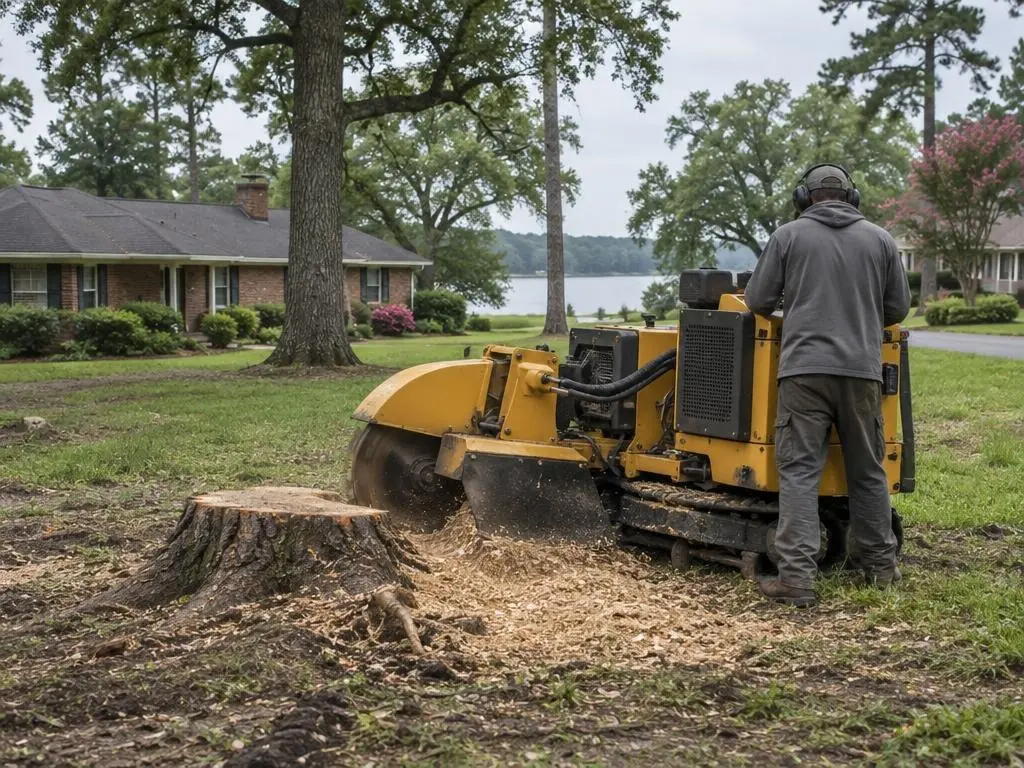
- Stump grinding so a yard can be leveled and replanted
- Tree health checks for trees that leafed out thin, dropped limbs or have fungus at the base
- Clearing overgrown fence lines, alleys and back corners of older lots
Power lines and trees near the street
SWEPCO keeps the primary, secondary and neutral wires on its poles clear of trees, and you should leave anything touching those wires to its crews. The service line from the pole to your house is a different story: SWEPCO puts that on the property owner and will disconnect it for the work if you call at least two working days ahead, so we plan pruning around that appointment. Trees in the neutral strip between the sidewalk and the curb are normally maintained by the property owner too, but the city's forestry crew will come look at one and advise you, and it handles dead limbs and dead trees in the right-of-way itself. Call 318-673-6330 if you are not sure whose tree it is.
Getting an estimate
Call (318) 309-7506 or send the form with your address and a photo or two. We come out, look at the tree with you, and leave a written quote that spells out the cutting, hauling and stump work. Get a free estimate
What to Know in Shreveport
- Rain and heat. Shreveport averages about 51.43 inches of precipitation a year, with April the wettest month at 5.19 inches, and roughly 91 days a year above 90 degrees F. The record high of 110 F was matched in August 2023.
- Winter ice. The city averages about 35 days a year at or below freezing and only about 0.9 inch of snow, but ice and sleet storms are a known winter hazard here, which is why limb weight over roofs matters.
- Hurricane Laura, 2020. Laura was still a tropical storm when it passed about 50 miles east-southeast of Shreveport on August 27, 2020. In Shreveport a tree fell on a house and injured a person inside, and a large tree came down on the Centenary College campus.
- Street-side trees. Shreveport's Streets & Drainage division says trees in the neutral area between the sidewalk and the curb are normally maintained by the property owner. Its seven-person forestry crew removes dead limbs and dead trees in city right-of-way and will evaluate a neutral-area tree on request at 318-673-6330.
- Curbside limbs and brush. The city picks up limbs and brush from residents on request (318-673-6300 or Report a Concern). Pieces can be no more than 8 inches in diameter or 6 feet long, one pile up to 15 x 6 x 6 feet, and the city does not collect stumps, roots or debris left by contractors.
Our Services in Shreveport, LA
Shreveport Questions
Do I need a permit to cut down a tree on my own lot in Shreveport?
For a house lot, generally no. Shreveport's Unified Development Code has no heritage or protected-tree list for private yards; its tree provisions mainly cover landscape plans for development, with credit for saving trees 8 inches or more in caliper. Ask first if the tree may be in city right-of-way, if your subdivision has deed restrictions, or if the house is in a local historic district such as South Highlands, where the Historic Preservation Commission reviews exterior changes. We will flag anything that looks like right-of-way or a shared line tree when we visit.
A tree limb is lying on the power line to my house. Can you remove it?
Call SWEPCO first and keep everyone away from the line. Once the utility has cut power or cleared the line, we can remove the rest of the limb and the tree if needed.
Is it better to prune a big oak before or after spring storms?
Before. Late winter, when the tree is dormant and leaves are off, is the best time to see the structure and remove weak or dead limbs. Waiting until after a storm usually means paying for cleanup and damage on top of the pruning.
Can you take a tree down in a small backyard with no access for a truck?
Usually, yes. In older Shreveport neighborhoods we often climb the tree, cut it in sections and lower each piece by rope, then carry or wheel it out to the street. The estimate will explain how the job will be done on your lot.
Free Estimates in Shreveport, LA
Free on-site estimates anywhere in Shreveport.
Tree Service Near Shreveport
- Tree Service in Bossier City, LA
- Tree Service in Benton, LA
- Tree Service in Haughton, LA
- Tree Service in Red Chute, LA
- Tree Service in Eastwood, LA
- Tree Service in Plain Dealing, LA
- Tree Service in Blanchard, LA
- Tree Service in Greenwood, LA
- Tree Service in Keithville, LA
- Tree Service in Mooringsport, LA
- Tree Service in Oil City, LA
- Tree Service in Vivian, LA
- Tree Service in Belcher, LA
- Tree Service in Gilliam, LA
- Tree Service in Hosston, LA
- Tree Service in Stonewall, LA
- Tree Service in Waskom, TX
- Tree Service in Doyline, LA
- Tree Service in Minden, LA
- Tree Service in Dixie Inn, LA